Don't Fear Recursion
Recursion scares people for one reason: they try to run the whole thing in their head before writing a single line. All the way down, all the way back up, holding every half-finished call at once. Nobody can do that, and you don’t need to.
Two habits are enough: one for writing a recursive function, and one for reading it.
Trust the function when you write it. Focus on one step when you trace it.
Trust the function
Don’t think about recursion before writing the function. Just assume it already does what you want.
Say f(n) solves your problem for n. To solve n, you need the answer for n - 1. And who solves n - 1? f(n - 1) does, because you just assumed so. Call it and use the answer. Need n - 2 as well? Call f(n - 2).
Then add one rule you already know the answer to, one that doesn’t depend on any other problem. That’s the base case, and it’s what stops the calls. Done.
- Promise what
f(n)returns, in one sentence. - Base case: answer the input you already know, without any further calls.
- Everything else: call
fon a smaller input and trust the answer.
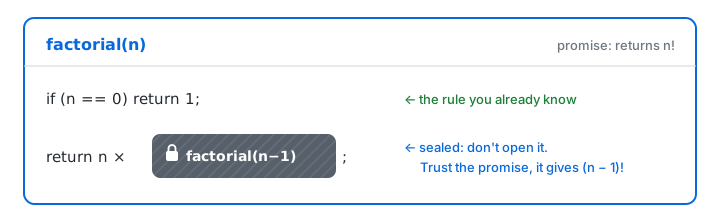
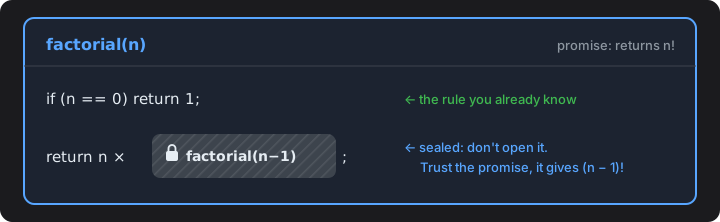
Take $n!$. You don’t need to know what $7!$ is. You know $0! = 1$, and you know $n! = n \times (n-1)!$. That’s the whole function.
1
2
3
4
5
// promise: factorial(n) returns n!
int factorial(int n) {
    if (n == 0) return 1;           // the rule you already know
    return n * factorial(n - 1);    // trust it to return (n-1)!
}
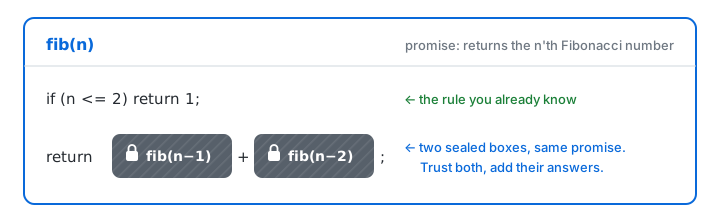
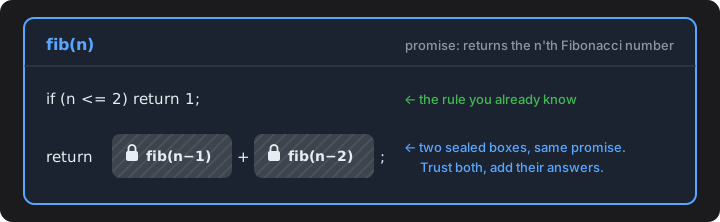
Fibonacci needs two smaller answers, so trust two calls.
1
2
3
4
5
// promise: fib(n) returns the n'th Fibonacci number, fib(1) = fib(2) = 1
int fib(int n) {
    if (n <= 2) return 1;
    return fib(n - 1) + fib(n - 2);
}
The trust only holds if every call gets closer to a base case.
factorial(-1)steps right past0and never stops, until the program crashes.
“Smaller” doesn’t have to mean n - 1. It can be the rest of an array (index i + 1), half of it (binary search), or the same string with both ends trimmed (palindromes). And when the smaller answer isn’t enough to build yours, promise more. To find the second-largest number, the second-largest of the rest won’t do; return the largest and the second-largest together.
Trace one step at a time
Writing is the easy half. The next problem is visualizing the calls, when you debug, or read someone else’s code. The trick is to compartmentalize.
When you’re on the step for n - 1, think only about n - 1: its variables, its lines. Not n, not n - 2.
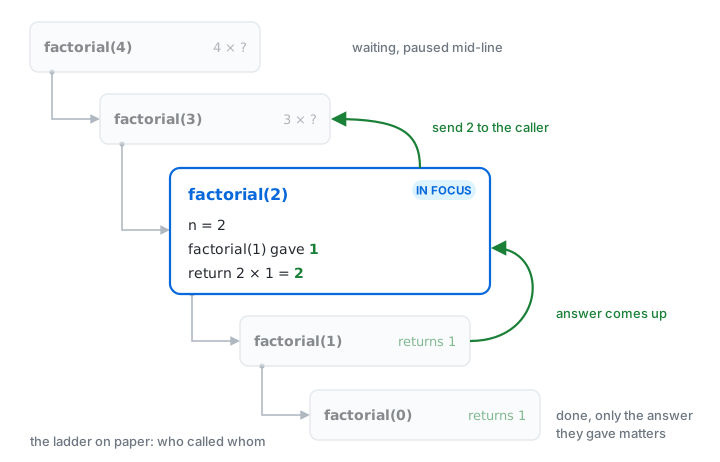
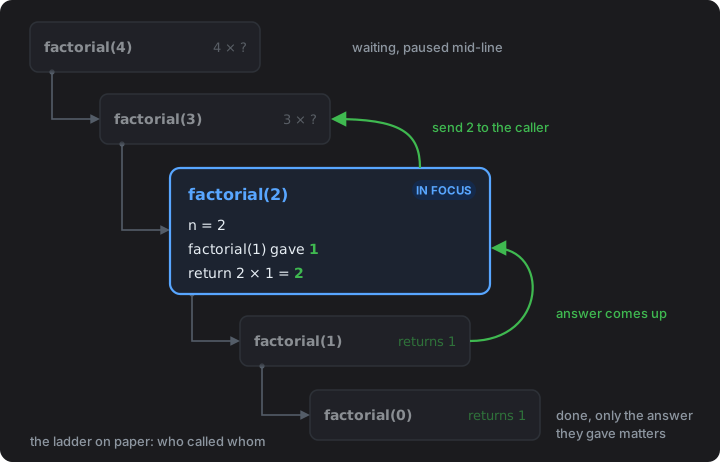
But keep a ladder on paper: where did you reach n - 1 from? When you know the answer for n - 1, the ladder tells you who to hand it to. Now you’re back at n, and once again, you focus on n alone. Not n - 1, not n + 1.
 Tracing
factorial(4), now at factorial(2). The answer comes up from below; the ladder says where to send it.
Written out, the whole trace is a staircase, down to the base case and back up.
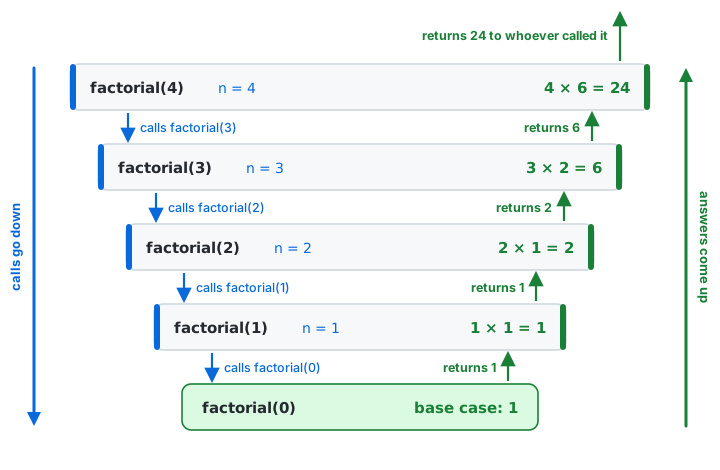
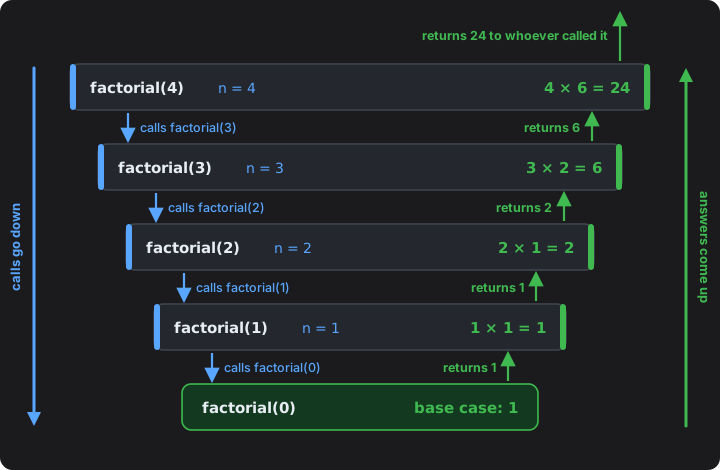
Every rung only needs the answer from the rung right below it. You never hold more than one step in your head; the ladder holds the rest.
Before the call, after the call
Any loop can be written as recursion. A loop, and its recursive twin:
1
2
3
for (int i = 0; i < n; i++) {
    printf("%d ", i);
}
1
2
3
4
5
void forward(int i, int n) {
    if (i == n) return;    // the loop condition, flipped
    printf("%d ", i);      // the loop body
    forward(i + 1, n);     // the next iteration
}
Swap the last two lines, and the same calls print backward:
1
2
3
4
5
void backward(int i, int n) {
    if (i == n) return;
    backward(i + 1, n);    // all the way down first...
    printf("%d ", i);      // ...then print on the way back up
}
forward(0, 5) prints 0 1 2 3 4, and backward(0, 5) prints 4 3 2 1 0. Each step pauses at its call, and the line after the call runs only when the answer comes back, deepest step first.
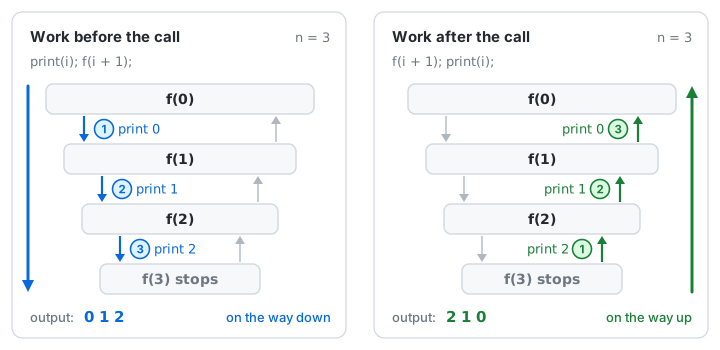
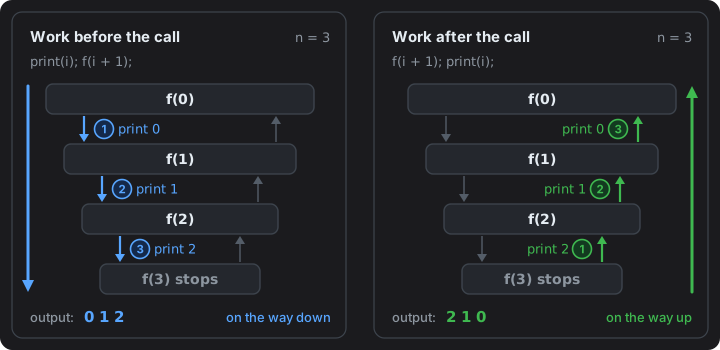 Same calls, same order. Only the position of the work changes.
Work before the call happens on the way down, in calling order. Work after the call happens on the way back up, in reverse. That one rule solves a good share of the practice problems.
The ladder is the call stack
The ladder isn’t just a study aid. It’s exactly what the machine keeps. Each call gets a frame: its own copy of the parameters and locals, plus the spot in the caller to return to. A call pushes a frame, a return pops one, and only the top frame runs. Everything under it is paused mid-line, waiting for an answer, just like the blurred steps of the ladder.
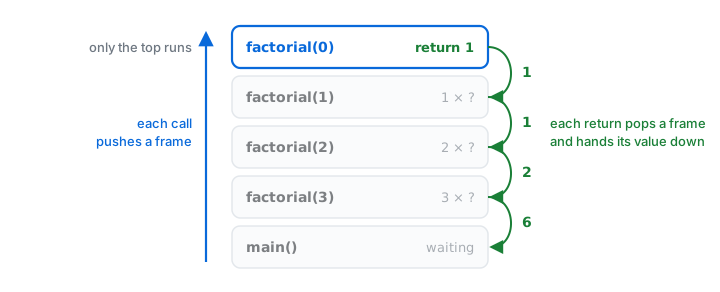
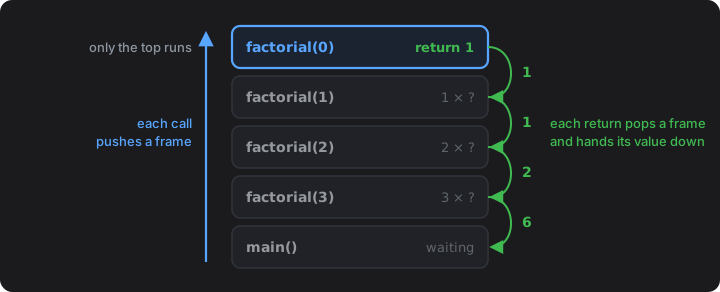 The stack during
factorial(3).
Recursion gives you a stack for free. Some algorithms need a stack, and recursion lets them use the call stack instead of an explicit stack data structure. Depth-first search (DFS) is the classic example: every paused call remembers the node it came from, so when the search hits a dead end, it simply returns and carries on from there.
Write the same DFS with a loop, and you have to push and pop that stack yourself.
Recursion can be expensive
Two costs to watch for:
- Depth. Every frame holds stack memory until it returns, and the stack is small: 8 MB by default on Linux and macOS, and 1 MB on Windows with MSVC (2 MB with MinGW). Even a function as small as
factorialoverflows the 8 MB stack a little past 250,000 levels in an unoptimized build, and crashes with a stack overflow where the same loop would run fine. An optimizing compiler can sometimes turn simple recursion into a loop, but don’t count on it. Depth $O(\log n)$ is always safe, and depth $O(n)$ is fine while $n$ stays small. Python cuts it even shorter, at 1000 levels by default. - Repeated work.
fib(n)asks forfib(n - 2)directly, and again insidefib(n - 1), and the repeats compound all the way down:fib(40)makes over 200 million calls.
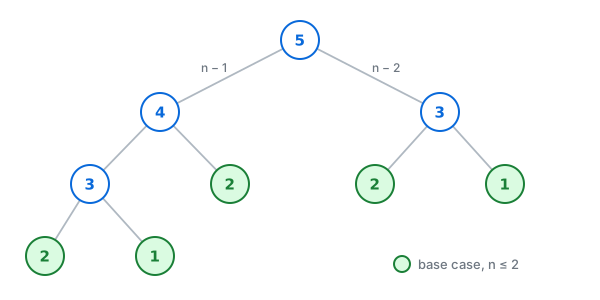
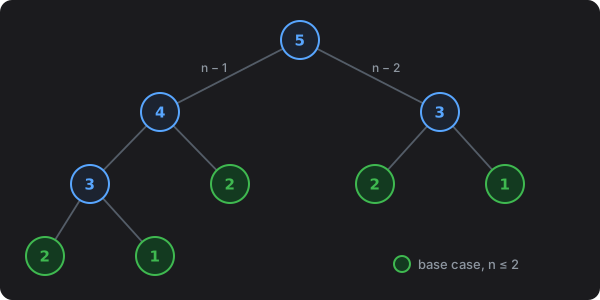 Calls made by
fib(5). fib(3) is computed twice, fib(2) three times.
The fix: store each answer the first time you compute it and look it up after that. That’s memoization, $O(n)$ calls instead of exponential, and the doorway to dynamic programming. For a truly huge $n$, matrix exponentiation gets there in $O(\log n)$.
Practice, practice, and practice!!!
Recursion is often how a problem is defined mathematically in the first place, and any other formulation would be much longer. It is also one of the most useful tools for designing divide-and-conquer and dynamic programming solutions, because it lets you see how a problem relates to its subproblems. But it’s a habit more than a technique: trust the call when you write it, and focus on one step when you trace it. Build the habit on 20 practice problems (PDF), ordered from printing an array backwards to the Tower of Hanoi.
Yes, an iterative solution is usually faster to execute, but recursion was the first solution.
And if you ever forget what recursion is
Recursion (noun): see recursion.
Originally posted on my old blog, I, ME AND MYSELF !!!, on December 10, 2009, as notes for a first-year programming course. Rewritten here for anyone learning recursion, around the two habits I still recommend.